
Empower Your Energy Community With Real-Time Insight, Shared Revenues, and Market Integration
INOWATTIO gives energy communities the digital tools to manage shared energy, visualize internal flows, automate settlements, and participate together in flexibility and energy markets.
Energy Community Management, Simplified
INOWATTIO provides a single, integrated platform to handle the critical administrative tasks of running a successful energy community, turning complexity into a seamless, automated process.


Member & Asset Management
Onboard new members, register their assets (solar, batteries, EVs), and manage roles and permissions effortlessly.

Energy Balancing & Accounting
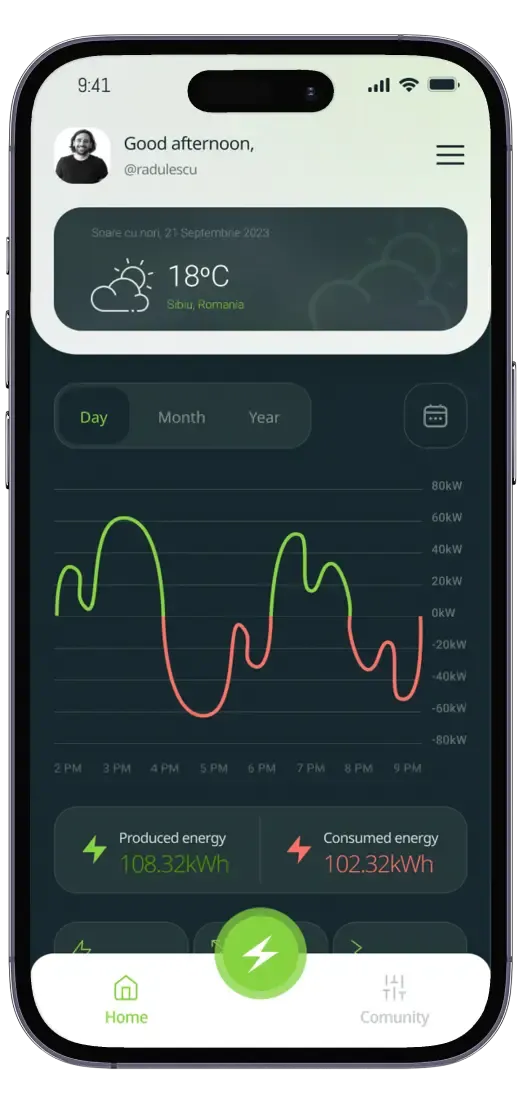
Our system automatically tracks all internal energy flows in real-time, providing a clear, auditable ledger of who produced and consumed what.

Automated Financial Settlement
We handle the entire financial loop—calculating credits for producers, debits for consumers, and generating clear monthly statements for everyone.

Regulatory Compliance
We automate the complex but crucial communication with energy suppliers, ensuring that internal exchanges are correctly reported as block transfers to avoid double-charging and ensure compliance.
Advanced Market Connectivity
Group Flexibility Market ParticipationEnergy communities can aggregate shared batteries, flexible loads, and surplus solar generation. INOWATTIO creates capacity offers, manages TSO interaction, dispatches assets during balancing events, and distributes rewards proportionally among members.
 PZU + Intraday Trading Dashboards
Energy managers get an integrated trading cockpit for Day-Ahead (PZU) bidding, Intraday adjustments, production forecasting, and arbitrage and internal balancing optimization.
 OPCOM & DAMAS Integration
Native interfaces for seamless market operation allow you to submit offers & trades directly to OPCOM, receive TSO activations via DAMAS, and benefit from automated market reporting & compliance.
Automated SettlementAfter market participation, our platform handles the complex financial settlement, attributing revenue from grid services back to the community and its individual members based on their verified contribution.
Why Energy Communities Choose INOWATTIO

Total Transparency
Everything — flows, invoices, contributions — is visible in real time.
Automated Settlement
From member balancing to supplier block transfers, no manual work is needed.
Revenue Streams
Communities earn together by participating in flexibility and energy markets.
Energy Community Flow Overview

Members generate & consume energy

INOWATTIO measures internal flows continuously

Community balance is calculated

Block transfers are sent to suppliers

Flexibility capacity is aggregated & sold

Monthly settlements and invoices are issued
ⓘ A Note on the Regulatory Status in Romania
The full operational framework for energy communities, including market integration and settlement protocols, is awaiting finalization by ANRE.
While these regulations are being developed, INOWATTIO offers your community the ability to get ahead.
Our platform is available today for monitoring, simulating, and optimizing your internal energy flows. By preparing now, your community will be technically and operationally ready to integrate seamlessly once the market is fully open.
Frequently Asked Questions
Answers to common questions about our platform and services.
What, specifically, is an energy community?
An energy community is a group of members (consumers and/or producers) who collectively organize their energy production, consumption, and sharing. The idea is simple: locally produced energy can partially cover the consumption of other members, and the benefits are distributed according to a clear rule.
Do I need to have solar panels to join a community?
No. You can be just a consumer. In a community, there are:
- members who produce (prosumers / PV / batteries)
- members who consume (without production)
- and sometimes common assets (community PV, common battery).
Can I stay with my current supplier if I join a community?
Yes. Members retain the right to choose their supplier. The community does not 'take' your supplier. In practice, shared energy supplements the energy purchased from the supplier (residual consumption).
If I have a supplier, why do I still need the community?
Because the supplier sells you energy from the market. The community can:
- reduce a portion of the energy purchased from the grid (through shared energy)
- offer you transparency and a logic for sharing benefits
- and in the medium term, it can also generate revenue from flexibility (batteries, EVs, controllable consumption).
What real benefits can I get as a member?
Typically (depending on the model and implementation):
- cheaper energy than from the grid for a portion of your consumption
- better cost stability (in certain scenarios)
- transparency: you know who produced, who consumed, and how it was distributed
- possible shared revenues (if there is surplus production or monetized flexibility).
How is energy shared within the community?
Normally, there is an allocation rule. Common examples:
- proportional to each member's consumption
- fixed quota / percentage established by statute
- priorities (e.g., school / town hall / vulnerable consumers)
- combinations (e.g., guaranteed minimum + proportional).
Important: the rule must be clear, verifiable, and stable.
Does the community 'replace' the supplier?
No. The community is not a supplier (in the standard model). The supplier remains the one who bills for energy from the grid (residual consumption) and manages the contractual supply relationship.
The community manages internally shared energy and internal settlements.
What data do I need to provide as a member?
Typically the POD, technical data about your installation (if you produce: PV/battery) and agreements/mandates for data access (where necessary).
We are not talking about excessive 'personal data,' but about the operational data necessary for energy to be settled correctly.
Is a smart meter required?
It helps enormously. With data at short intervals (e.g., 15 minutes), you can correctly allocate energy among members, reduce estimations and avoid crude monthly corrections.
Without granularity, energy sharing becomes more of a post-facto reconciliation than real operation.
What happens if the community doesn't produce enough in a month?
Then your residual consumption increases, and you will buy more from your supplier. You will not be left without power, and there is no 'supply risk'. The community only reduces how much you buy from the grid when it has a surplus.
Can communities sell energy on the market?
Yes, in the 'advanced' model, if there is a mandated party/aggregator with market capabilities (Day-Ahead/Intraday) and a forecasting + operational structure. However, most communities start with the 'passive' model (internal compensation).
What does INOWATTIO do specifically for communities?
INOWATTIO offers:
- member, POD, and asset management
- monitoring and visualization of internal flows
- calculation of internal allocations and settlements
- monthly reports and settlement documents
- support for integration with suppliers/aggregators and preparation for markets/flexibility (where the framework allows).
Who 'administers' the community in the platform?
A delegated member (established by the community's governance) has administrative access: onboarding, roles, approvals and settings.
 Learn More