
Smart Aggregation and DER Dispatchability for Romania’s Energy Market
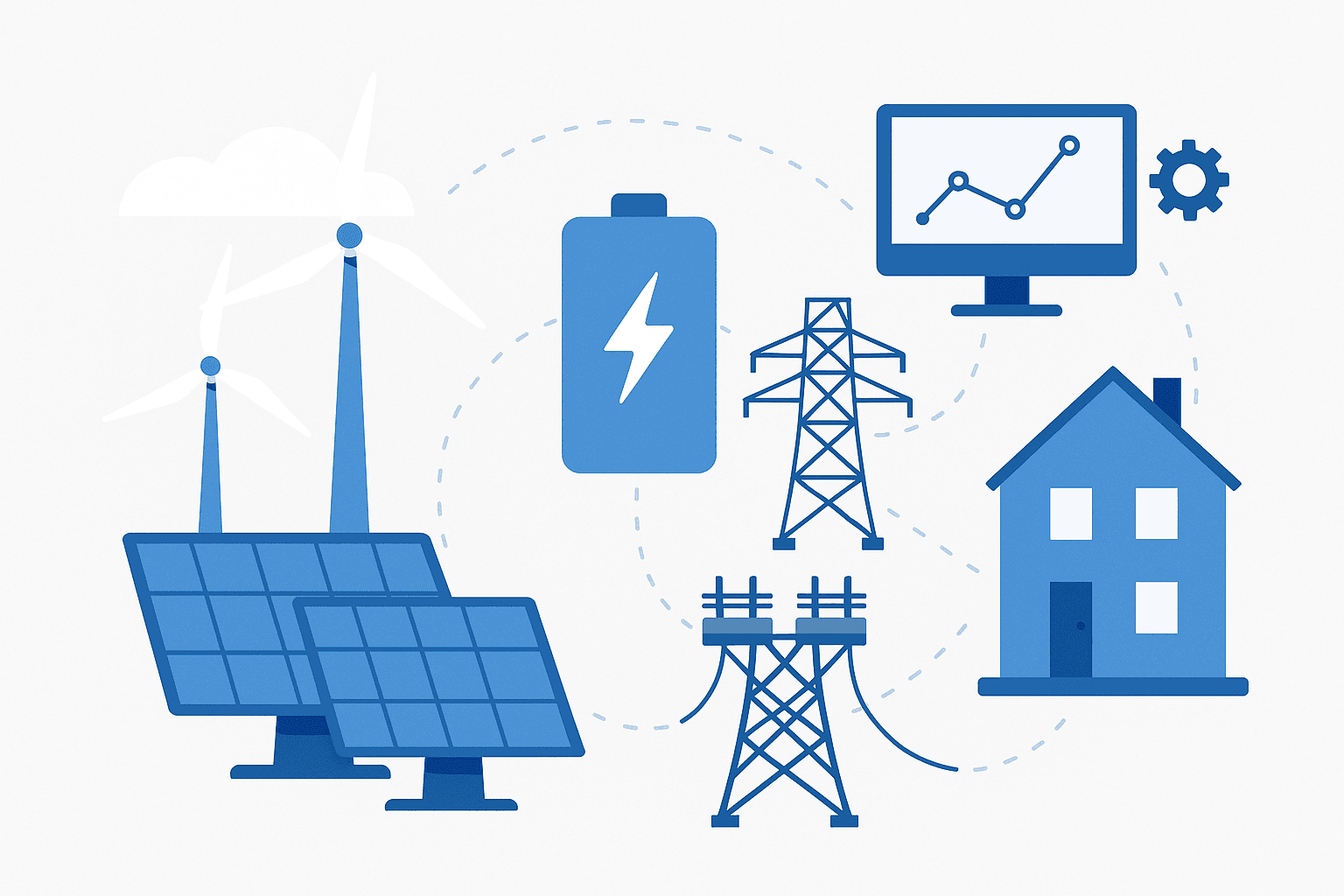
INOWATTIO enables the real-time aggregation and dispatch of distributed energy resources (DERs) — solar, batteries, and flexible consumers — into a unified, controllable network. Through intelligent coordination and market integration, decentralized flexibility becomes a stable and valuable asset for Romania’s energy grid.
Smart Aggregation and DER Dispatchability in Romania
From centralized generation to distributed flexibility
The global energy system is undergoing a structural transformation, and Romania is no exception. Traditional models based on large, centralized generation assets are increasingly complemented by distributed energy resources (DERs) deployed closer to consumption points. Across the country, residential and commercial solar installations, battery systems, flexible industrial loads, and electric vehicle charging infrastructure are expanding at pace.
This shift supports decarbonization and can improve energy security, but it also increases operational complexity. Distributed assets are variable by nature: solar output depends on weather, charging patterns depend on user behavior, and flexible loads have operational constraints that limit how and when they can respond. Without coordination, growing decentralization can amplify ramps, congestion, and local voltage issues—especially at the distribution level where many DERs connect.
Smart aggregation and dispatchability are the mechanisms that convert decentralized flexibility into a reliable, controllable system resource. Instead of thousands of assets behaving independently, aggregation creates portfolios that can be scheduled, activated, measured, and verified—enabling DERs to contribute to system stability and to participate economically in balancing mechanisms.
What are distributed energy resources (DERs)
Distributed energy resources include any energy-producing, storing, or controllable consuming assets connected at the distribution level (or behind the meter) that can influence net power flows. Common examples include photovoltaic (PV) systems, battery energy storage systems (BESS), controllable industrial processes, commercial buildings with automated demand management, thermal storage, and EV charging infrastructure.
From a grid perspective, DERs matter because they change both the magnitude and timing of local consumption and generation. A high concentration of PV can create midday export peaks and evening import peaks. Batteries can reduce peaks, but only if they are controlled intelligently. Flexible loads can shift consumption, but only if they can be coordinated without disrupting operations.
Individually, most DERs are too small to interact directly with energy markets or system operators. They may also lack the telemetry, metering quality, or control interfaces required for market participation. Aggregation bridges this gap by pooling many small resources into one operational entity that meets minimum thresholds for power, performance, and compliance.
Aggregation explained in practical terms
Aggregation is the process of grouping multiple DERs into a single virtual entity that can be managed as one operational unit. Think of it as building a “virtual power plant” (VPP) out of distributed assets. Instead of controlling each solar inverter or battery independently as an isolated system, an aggregation platform coordinates them under a unified control strategy.
In practice, aggregation requires more than simply summing capacities. A portfolio must be characterized by:
- Available flexibility: how much upward or downward adjustment is realistically deliverable at each interval.
- Constraints: device limits, state of charge boundaries, contractual restrictions, and site-level priorities.
- Telemetry quality: sufficient monitoring resolution and reliability to support control, settlement, and verification.
- Control pathways: secure and deterministic command channels to execute dispatch actions within required response times.
Once aggregated, the virtual entity can increase or decrease net power injection, shift consumption patterns, or activate storage capacity in response to grid requirements. Aggregation transforms fragmented flexibility into a measurable, dispatchable resource that is visible to system operators and eligible for market activation.
Why aggregation is critical for Romania’s energy system
Romania’s rapid growth in renewable generation—particularly solar—creates both opportunity and challenge. Intermittent generation increases the need for flexibility to maintain system balance, manage ramps, and reduce operational costs associated with reserve procurement. At the same time, many new renewable and behind-the-meter assets connect at distribution level, where visibility and controllability can be limited.
Aggregation addresses these issues by enabling local flexibility to be sourced from distributed portfolios rather than relying only on centralized reserves. This can reduce curtailment risk, improve hosting capacity on congested feeders, and minimize the need for immediate grid reinforcements. It also enables smaller resources to participate fairly in balancing mechanisms instead of remaining passive participants subject to export limits or suboptimal self-consumption.
In addition, aggregation supports better forecasting and system planning. Portfolio-level forecasts of PV output, load behavior, and flexibility availability provide system operators and market participants with improved predictability—an essential requirement for reliable scheduling and activation.
Understanding DER dispatchability
Dispatchability refers to the ability to control energy resources in real time according to system needs. For conventional power plants, dispatchability is typically inherent: operators can adjust output by setpoint. For DERs, dispatchability must be engineered through digital control, reliable telemetry, and robust operational rules.
Flexibility only has operational value if it can be activated precisely and consistently within defined response times. Dispatchability requires:
- Real-time command execution: setpoint changes must reach field devices quickly and deterministically.
- Continuous measurement: response must be measured accurately to confirm delivery versus target.
- Automated correction: deviations must trigger corrective actions without manual intervention.
- Safety and constraints enforcement: device and site limits must never be violated during activation.
Smart dispatchability ensures that aggregated DER portfolios respond predictably to grid signals, whether by adjusting inverter output, modulating consumption, or activating stored energy from batteries.
How real-time dispatch works in practice
Within an aggregated portfolio, each DER is modeled with technical and operational constraints. Batteries have state-of-charge limits, inverters have export caps, industrial loads have minimum runtime requirements, and EV chargers have user deadlines. An aggregation platform uses these constraints to determine what flexibility is available at each interval.
When a balancing request or grid signal is issued, the platform selects a set of resources that can deliver the requested response while minimizing disruption and respecting constraints. For example, a downward flexibility activation (reduce net load or increase net export) might be delivered through a combination of battery discharge, export ramp-up from PV (where possible), and load curtailment of non-critical processes. An upward flexibility activation might be delivered through battery charging reduction, controlled load increase, or reduced export.
Execution is monitored continuously. Telemetry streams are compared against target setpoints and expected response curves. If deviations occur—due to local constraints, communication delays, or asset availability changes—the platform reallocates dispatch across other resources or applies corrective setpoints. The portfolio must behave like a single controllable resource even though it is physically distributed.
Measurement, verification, and performance accountability
For dispatchability to be valuable in market contexts, delivery must be measurable and verifiable. This requires accurate metering, time alignment, and clear baselines. Depending on the program design, verification may rely on direct metering at the point of connection, device telemetry, or a combination of both.
At the portfolio level, the platform typically maintains:
- Activation logs: what was commanded, when it was commanded, and to which assets.
- Telemetry traces: measured response per asset and aggregated response over time.
- Compliance checks: validation against operational constraints and dispatch rules.
- Settlement inputs: the data needed to support financial settlement and reporting.
High-quality verification reduces non-delivery risk, supports reliable market participation, and enables transparent reporting to participants and stakeholders.
The role of INOWATTIO in aggregation and dispatch
INOWATTIO provides the digital infrastructure that enables aggregation and real-time dispatchability of DERs at scale. The platform connects distributed assets into a unified system capable of handling high data volumes, enforcing operational rules, and coordinating responses across geographically dispersed resources.
From the participant’s perspective, assets retain local priorities and safety constraints while contributing flexibility to the aggregated portfolio. From the grid’s perspective, the aggregated portfolio behaves as a single controllable resource: it can be scheduled, activated, monitored, and verified as one unit.
Operationally, the platform integrates several functional layers: onboarding and asset modeling, telemetry ingestion, forecasting and availability estimation, dispatch optimization, real-time control execution, and measurement/verification for settlement. This end-to-end chain is what enables DER portfolios to function reliably under balancing market requirements.
Integration with the balancing market
A major benefit of smart aggregation is participation in balancing mechanisms, where flexibility becomes an economic asset. In balancing contexts, the system operator procures services that maintain supply-demand balance and frequency stability in real time. These services require fast response, accurate tracking, and disciplined execution.
Aggregation allows small DERs to meet minimum thresholds collectively. It also supports the operational discipline required to deliver balancing services without excessive manual coordination. As market frameworks evolve, the ability to activate flexibility portfolios reliably becomes a competitive advantage for aggregators and a new value stream for asset owners.
For Romania, enabling DER participation can improve system efficiency by sourcing flexibility closer to load centers. This can reduce congestion, limit transmission losses, and improve overall operational responsiveness.
Grid stability and operational value
Real-time DER dispatchability enhances grid stability by providing fast-response resources at distribution level. When coordinated properly, distributed flexibility can help manage local voltage behavior, reduce feeder overload risk, and smooth net load profiles. At the transmission level, aggregated portfolios can contribute balancing capacity and reduce reliance on centralized reserves.
In systems with high renewable penetration, flexibility is the resource that allows renewables to scale without compromising reliability. Aggregated DERs provide that resource through batteries, controllable demand, and coordinated export behaviors.
Benefits for prosumers and industrial participants
For asset owners, aggregation and dispatchability unlock value that would otherwise remain unused. Flexibility can generate revenue through market participation or reduce energy costs through peak reduction and improved self-consumption. For industrial participants, coordinated control can stabilize energy flows and reduce exposure to price volatility and demand peaks.
Just as importantly, smart control improves internal energy management. Batteries are cycled more efficiently, EV charging is aligned with availability and constraints, and controllable loads are shifted in ways that preserve operations while creating measurable flexibility.
A scalable model for Romania’s future energy system
Aggregation and dispatchability form the backbone of future smart grids. As electrification expands and renewable penetration increases, digital coordination becomes indispensable. Romania’s technical readiness and evolving market frameworks position the country well for this transition, but scaling will require robust platforms, disciplined verification, and well-designed operational policies.
As DER adoption grows, portfolios will become larger, more diverse, and more dynamic. Dispatchability will shift from being a niche capability to an operational standard, shaping how distribution networks are planned and how balancing mechanisms are supplied.
From distributed assets to dispatchable power portfolios
The evolution from isolated DERs to aggregated, dispatchable portfolios marks a fundamental shift in energy system design. Control moves from static schedules to dynamic, data-driven decision-making. Instead of treating distributed resources as uncertain noise on the grid, aggregation turns them into structured and controllable capacity.
This approach aligns economic incentives, grid stability, and sustainability objectives. It enables higher renewable penetration, reduces curtailment risk, and creates a resilient energy ecosystem capable of adapting to future challenges.
The future of smart energy in Romania
Smart aggregation and DER dispatchability are not temporary innovations. They are foundational elements of the modern energy system. As renewable capacity continues to grow, so does the need for intelligent coordination that can convert variable distributed resources into dependable operational capability.
By transforming decentralized flexibility into a measurable and dispatchable system resource, aggregation platforms support Romania’s transition toward a more secure, efficient, and sustainable energy market—one where distributed assets contribute not only clean energy, but also stability and controllability.

 See All Posts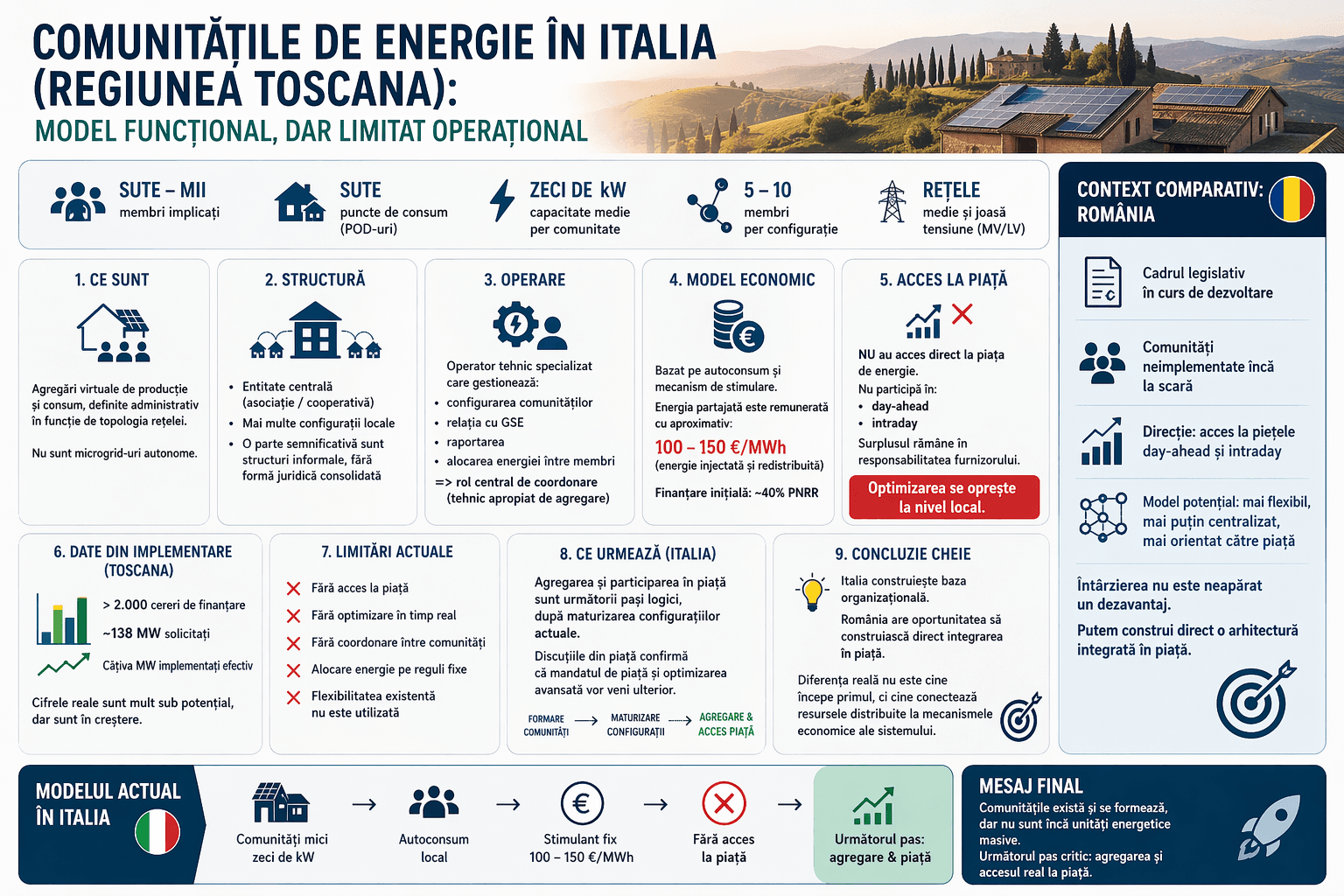
 May 8, 2026 | 3 min read
Energy communities in Italy (Tuscany): a functional model, still early in operational maturity
Energy communities in Italy, particularly in the Tuscany region, are already implemented and operational, but in a simplified form compared to how the model is often described at EU level. The focus is on speed: rapid formation, clear incentives, and strong local engagement.
Field data shows these communities are still operating mainly as local optimization structures, without real market integration. The difference compared to Romania is not just about timing, but about system architecture.
 Mar 6, 2026 | 1 min read
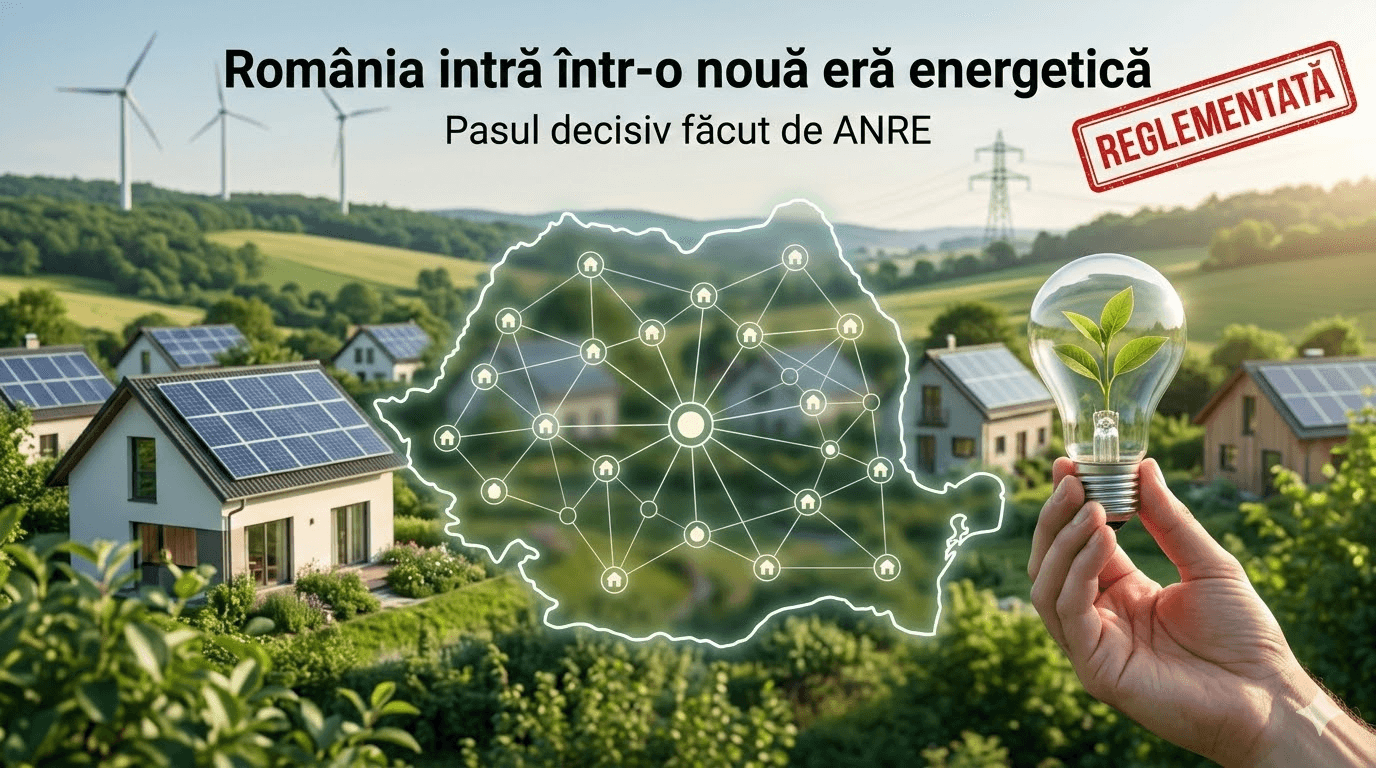
Energy Communities Become Reality in Romania After ANRE Decision
ANRE takes a major step toward decentralizing Romania’s energy system. The new proposed regulations create, for the first time, a real framework for the emergence of energy communities and local energy markets.
 Feb 12, 2026 | 7 min read
Industrial Renewable Integration Made Simple
Romania’s industry is entering a new energy era. INOWATTIO’s hybrid SCADA–IoT platform connects solar panels, batteries, and industrial consumption into one intelligent system that cuts costs, enhances control, and enables participation in the balancing market. A new standard for efficiency, resilience, and sustainable energy management.